
Free Running vs Screw Lock vs Tangless: Which Wire Thread Insert Does Your Application Need?
Oct 1, 2026
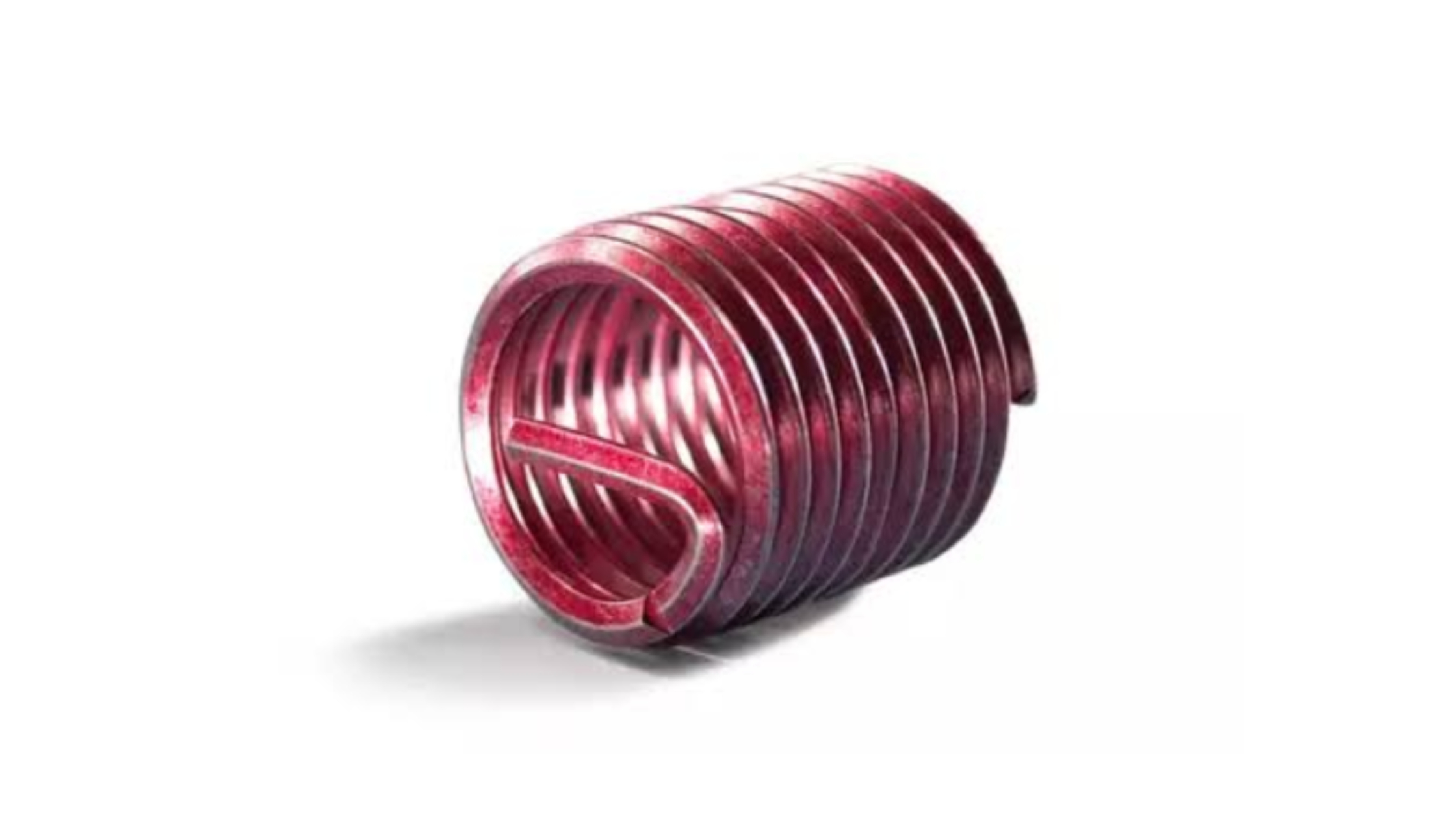
Wire thread inserts all look similar at first glance: a small coil of stainless steel wire that creates a strong internal thread. In practice, the variant you choose affects how the joint behaves under vibration, how easy it is to install, and even which tools you need. This guide compares free running, screw lock and tangless inserts, along with Twinserts, oversize and special-material options, so you can match the right insert to your application.
How Wire Thread Inserts Work
A wire thread insert is formed from wire with a diamond-shaped profile, coiled into a precise spiral. Once installed in a tapped hole, it acts as a hard, smooth internal thread that distributes load along the full length of engagement. Böllhoff explains that the insert transfers forces from flank to flank into the holding thread, which is why these inserts are so widely used to reinforce threads in aluminium, magnesium alloys and plastics. The same technology is covered for metric sizes by ASME B18.29.2M, which sets out dimensional, mechanical and performance data for free running and screw-locking inserts.
Compared with a thread tapped directly into soft metal, an insert offers several practical benefits. It resists wear from repeated assembly, reduces the risk of galling between the fastener and the parent material, and often allows a smaller boss or flange because the load is spread more evenly. It also gives designers a repair path: if a thread is damaged in service, it can be restored rather than the part being scrapped.
Free Running Inserts
Free running inserts provide a smooth thread along their whole length. The fastener turns freely until it is tightened, just as it would in a well-made tapped hole. They are the default choice for general thread repair and for reinforcing threads in soft materials where parts are assembled and disassembled regularly, such as aluminium housings, inspection covers and electronics enclosures. They are also the natural choice for thread repair kits used in general maintenance, since most repairs simply need the original thread restored.
Because they add no locking torque, free running inserts rely on the fastener’s preload, or on a separate locking method, to stay secure. For static or low-vibration joints, this is usually all that is needed. The standard range of free running HeliCoil inserts covers metric, UNC and UNF sizes in several lengths.
Screw Lock Inserts
Screw lock inserts include one or more deformed coils that grip the fastener’s thread. This creates a prevailing torque that resists loosening under vibration and shock, without needing lock wire, lock nuts, washers or thread-locking compounds. Stanley Engineered Fastening states that its screw-locking inserts provide positive self-locking torque complying with NASM8846, and that the resilient screw-lock allows frequent removal and reassembly without significant loss of torque.
Screw lock inserts suit engines, pumps, compressors, vehicles and any assembly subject to cyclic loads. They are colour coded for identification. Stanley’s standard screw-locking HeliCoil inserts are among the most widely specified in this category.
Tangless Inserts
Conventional inserts have a driving tang at the bottom that is broken off after installation. Tangless inserts remove the tang entirely, so there is nothing to break off or retrieve. This makes them the preferred option where foreign object debris cannot be tolerated, such as aerospace, electronics and precision assemblies, and it also saves installation time. In production, removing the tang break-off and retrieval steps from every cycle can make a noticeable difference to throughput.
Both manufacturers offer a tangless solution. The Stanley HeliCoil inserts in the Tangless family are available in free running and screw-locking versions and can be adjusted or removed after installation. The Bollhoff HeliCoil inserts in the Tangfree family work on the same principle and can be set and inserted like a screw. Note that tangless inserts need their own installation tools, so they are not a drop-in replacement for tanged tooling.
Twinserts, Oversize and Special Materials
Some applications need more than a standard insert. Twinserts use an outer insert installed into an oversized tapped hole, with an inner insert fitted inside it to create a standard thread. They are used to recover holes that are badly stripped, cracked or off-centre, where a single insert would not hold. The Twinsert range includes the inner and outer inserts, taps and gauges needed for these repairs.
Oversize inserts suit holes that have already been enlarged beyond a normal repair. Special materials such as Nitronic 60 are used where galling resistance or higher strength is needed, while standard 304 stainless inserts cover most general work and, according to Stanley, can be used across a very wide temperature range.
Choosing the Right Insert for Your Application
A few practical questions narrow the choice quickly. Will the joint see vibration or cyclic loading? If so, screw lock is usually the safer option. Is loose debris a risk? Choose tangless. Is the hole already badly damaged or cracked? Consider a Twinsert or oversize insert. Is this a general repair or a thread reinforcement in soft metal with regular disassembly? A free running insert is usually ideal.
It also helps to think about the whole life of the part. A thread that will be assembled once at the factory and rarely touched may only need a free running insert. A service access point that technicians open every few months benefits from an insert that holds up to repeated assembly, and screw lock inserts add security if the equipment vibrates. Where parts are reworked or refurbished, choosing a family with matching extraction tools makes later replacement simpler.
Insert length matters too. Longer inserts give more thread engagement, which helps in soft materials, but the hole must be drilled and tapped deep enough. Finally, consider tooling: tanged, tangless and Twinsert systems each use different installation tools, so standardising on one family simplifies production. For a step-by-step view of installation, see [LINK TO: Post 11 — How to Install a HeliCoil Insert: A Step-by-Step Thread Repair Kit Guide], and for a comparison of the two manufacturer ranges, see [LINK TO: Post 10 — Bollhoff vs Stanley HeliCoil Inserts: Understanding the Two Original HeliCoil Ranges].
Frequently Asked Questions
What is the difference between free running and screw lock inserts?
Free running inserts give a smooth thread with no added torque. Screw lock inserts have deformed coils that grip the fastener to resist loosening under vibration.
Are tangless inserts stronger than tanged inserts?
Not necessarily. The main advantage of tangless inserts is that no tang is left behind, which removes the debris risk and the tang break-off step.
Can I reuse a screw lock insert after removing the bolt?
Screw lock inserts are designed for repeated assembly, and Stanley states its resilient screw-lock allows frequent removal and reassembly without significant loss of torque.
Do different insert types need different tools?
Yes. Tanged, tangless and Twinsert inserts each have their own installation tools, so check tooling compatibility before switching types.
Where can I buy screw thread inserts in Singapore?
Thor International stocks free running, screw lock, tangless and Twinsert inserts from both Bollhoff and Stanley, with matching taps and tools.
Choosing between free running, screw lock and tangless inserts comes down to vibration, debris risk and the condition of the hole. Getting that choice right at the start avoids rework and keeps assemblies reliable in service. Browse the full range of wire thread inserts, or contact Thor International for screw thread inserts Singapore engineers trust, along with advice on the right insert type for your application.
References
- Böllhoff. (n.d.). HELICOIL® – Thread inserts for metals. Böllhoff. https://www.boellhoff.com/us-en/products/special-fasteners/helicoil-thread-inserts-for-metals/
- Stanley Engineered Fastening. (n.d.). Tangless® Screw Thread Inserts. Stanley Engineered Fastening. https://www.stanleyengineeredfastening.com/en/fasteners/inserts/wire-threaded-inserts/helicoil-tangless-screw-thread-inserts
- ASME. (2005). B18.29.2M – Helical Coil Screw Thread Inserts: Free Running and Screw Locking (Metric Series). ASME. https://www.asme.org/codes-standards/find-codes-standards/b18-29-2m-helical-coil-screw-thread-inserts-free-running-screw-locking


10 Ubi Crescent #01-80 Lobby E, 408564, Singapore

(65) 6743 4155

(65) 6743 4155

sales@thorintl.com

Mon - Fri: 9am - 5pm
Sat - Sun: Closed


MRT
Take the appropriate MRT line to the nearest station, then continue your journey by bus, walking, or a taxi/ride-hailing service.


Bus
Check the bus services near the company’s location, board the relevant bus, alight at the nearest stop, and walk a short distance to the office.